Last updated: February 2026
Most Kenyan organisations don’t have a marketing problem. No. They have a business visibility problem. You lose deals not because your service is weak, but because buyers can’t verify (quickly) you’re real before they reply to your email or WhatsApp message.
This guide shows you the minimum digital presence a serious business needs in Kenya in 2026, in the order you should fix it: Google → Website → Trust → AI. Si story mingi. Just very simple things to implement without anyone quoting figures that you or your assistant can do for free.
Key Takeaways
- If people can’t find you on Google Maps or basic search, every other marketing effort is uphill. The journey to build your credibility starts before the sales call, not during it.
- You don’t need a fancy website; you need a fast and clear one. Three pages done well beat ten pages done poorly.
- Trust pages (About, Pricing, Case Studies) close deals more than generic “Services” pages. Buyers need to trust you, not just understand what you do.
- A simple “source-of-truth” page makes it easier for AI tools to summarise you accurately. ChatGPT and Perplexity pull from your site – make sure they get it right.
- Start with a sprint – a 30-day, 60-day, 90-day plan – not an endless big project consisting of RFPs and other unnecessary steps. Done and working beats perfect but delayed.
What’s the minimum digital presence a serious business needs in Kenya in 2026?
Think of your digital presence as four layers that build on each other:
Layer 1: Findability (Google/Maps + basic search)
Before anyone considers you, they need to find you. This means claiming your Google Business Profile, showing up for “[your category] Nairobi” searches, and having clean, consistent info across directories.
Layer 2: Credible website baseline
A simple site with a clear offer, who you serve, and how to contact/pay. Mobile-first. Loads fast. No broken links. This is not 2010 when we were all about marvelling at that cool parallax scrolling and similar gimmicks.
Layer 3: Trust pages
About (who you are, how long you’ve been in market), Proof (testimonials, case snippets, logos), Security (how you protect data), and Pricing (even if just “ranges start at X” or “how we price”). These pages are where deals get won or lost.
Layer 4: AI & information hygiene
A “source-of-truth” page that AI tools can pull from. Cleaning up old, conflicting information so ChatGPT doesn’t tell people you closed three years ago.
This works whether you’re a 20-year-old institution with offline credibility but weak digital presence, a service business doing strong delivery with no system for visibility, or an early-stage startup that needs to look serious now.
Where do buyers actually verify you before they reply or pay?
Here’s what happens in Kenya, every single day:
- Someone gets referred to your business, or searches “[your category] near me” or “[your category] Nairobi.”
- They click Google Maps first. They check the photos, the address, the reviews. If your profile is blank or looks like a side-hustle, they’re already skeptical.
- They click through to your website. They skim for risk: “Is this legit? Who else have they worked with? How long have they been around?”
- Some will also check your LinkedIn, a directory listing, maybe X or Instagram, depending on the type of business and target audience. It’s a fact that while most millennials will still Google stuff or ask chatGPT or Gemini, GenZ will run straight to Tiktok.
- Even referrals get Googled. Your friend tells them you’re great, but they still type your name + “Kenya” into Google before they reply to your WhatsApp.
If any of these checkpoints fail – missing info, outdated website, no proof – you’ve lost credibility before the conversation even starts.
What should you fix first for the fastest credibility lift?
Use this prioritised checklist. Don’t try to do everything at once.
Must fix in 30 days
1. Claim and optimise your Google Business Profile
This is the single highest-leverage thing you can do. Most verification happens here. If you haven’t claimed it, someone else might (or Google might auto-generate one that’s wrong). Add:
- Accurate category, address, phone, hours (address is not necessary if you are a service business like mine. You can always delete it later and add Service Areas.)
- High-quality photos (storefront, office, team, work samples, logo)
- Services list
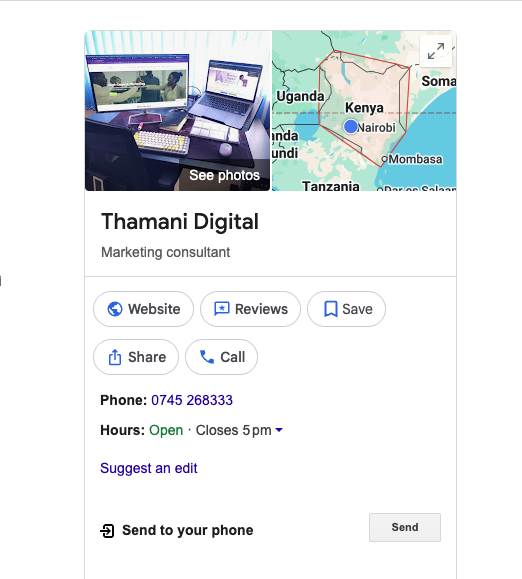
Share proactively to start getting reviews.
2. Create or fix a simple website with clear navigation
You need:
- Homepage that says what you do and who it’s for (one sentence)
- Services or What We Do page
- About page
- Contact page with phone, email, and (physical) address
- Mobile-responsive. Loads in under 3 seconds.
3. Add at least 3 clear proof elements
Logos of clients you’ve worked with, testimonials (even if just one-line quotes), or results summaries. Make it specific.
Should fix in 60–90 days
4. Build proper trust pages
Expand your About page to include how long you’ve been in business and why you exist. Add a dedicated Proof page (case studies, testimonials). If you handle sensitive data, add a Security page. If pricing is a common question, add a Pricing page (even if it’s just ranges or how you price).
5. Set up consistency across social handles and directory listings
Same business name, same tagline, same contact info everywhere. Clean up old profiles that say you’re “based in Westlands” when you moved to Kilimani two years ago.
Nice to have later
6. Blog content, webinars, fancy design layers
Only after the basics are solid. Most businesses skip the plumbing and jump straight to content, then wonder why nothing converts.
How do you set up Google Business Profile and basic web presence without wasting money?
Domain naming rules
- Use your actual business name. Avoid dashes, weird top-level domains(.biz, .info), or names that don’t match your brand.
- .com or .co.ke are safest. If your .com is taken, .co.ke is trusted in Kenya.
- Buy it from a Kenyan registrar (HostAfrica (formerly SasaHost), Kenyaweb, Safaricom, HostPinnacle) or international ones like GoDaddy or Namecheap.
Don’t over-engineer your tech stack
You don’t need a custom CMS or expensive hosting. Options that work well in Kenya:
- WordPress on shared hosting. The same registrars above provide hosting services.
- Simple static site (Carrd, Google Sites, or GitHub Pages) if you just need 3–5 pages.
- No-code builders (Wix, Squarespace) if you value speed over customisation.
I am all for WordPress here. I run all my sites on a shared hosting on GoDaddy.
Mobile-first is non-negotiable
Most verification in Kenya happens on phone. Test your site on a cheap Android device with slow 3G before you launch. If it doesn’t load or looks broken, fix it.
How trust pages convert
Trust pages are where deals close. Here’s what each one does:
About page
Answers: Who are you? How long have you been around? Why do you exist?
Example (legacy organisation):
“Founded in 2008, we’re a Nairobi-based compliance consultancy serving 60+ financial institutions across East Africa. We exist because too many good businesses lose licenses over fixable paperwork.”
Example (boutique agency):
“We’re a three-person content studio. Since 2020, we’ve helped 15 SaaS companies and professional services firms turn their founders’ expertise into lead-generating articles, playbooks, and LinkedIn content.”
Example (startup):
“Launched in 2024, we’re building field operations software for logistics companies in Kenya. Our founding team spent a combined 12 years at DHL and Sendy.”
Proof page
Case snippets, testimonials, client logos, certifications. Make it specific.
Don’t say: “We help businesses grow.”
Say: “Helped ABC Co reduce customer onboarding time from 14 days to 3 days (case study).”
Security/Compliance page
How you keep data safe. Relevant regulations or standards you follow (ISO, PCI-DSS, Kenya Data Protection Act compliance, etc.). Even if informal, say something: “We use encrypted cloud storage and sign NDAs as standard.”
Pricing page
Examples:
Transparent ranges or how pricing works. You don’t need to list exact numbers if you don’t want to.
- “Projects typically range from KES 150,000 to KES 800,000 depending on scope.”
- “Monthly retainers start at KES 80,000. Book a call to discuss your needs.”
- “We price based on team size and complexity. Most clients invest KES 200K–500K in Year 1.”
People aren’t always asking because they can’t afford you. They’re asking to make sure you’re not 10x what they budgeted or suspiciously cheap.
How does AI (and tools like ChatGPT/Perplexity) change your visibility stack?
AI tools summarise information from your website, public profiles, news mentions, and directory listings. If that information is outdated, conflicting, or missing, AI gets it wrong.
Example: Someone asks ChatGPT “Who is [Your Company]?” and it says you closed in 2022 because that’s what an old press release said. Or it mixes up your services because your LinkedIn says one thing and your website says another.
The solution: Create a “source-of-truth” page
This is a single page on your website that AI tools can easily pull from. It includes:
- Your official business name
- What you do (one clear sentence)
- Who you serve
- Key facts (founded year, team size, locations, notable clients or results)
- Contact info
Make it public, structured, and easy to parse. Name it /about or /company or something recognisable like these two.
Clean up old, conflicting information
Before you publish new content, audit what’s already out there:
- Old LinkedIn bios that say you’re still at your 2019 startup
- Directory listings with wrong phone numbers
- Press mentions that say you’re “a three-person team” when you’re now 15 people
Cleaning up is as important as publishing new stuff.
What does a practical 90-day visibility plan look like?
Here’s a realistic roadmap, but if you can do all these in a week, the better:
Month 1: Claim/optimise Google Business Profile, fix homepage + key service page, baseline proof
Week 1–2:
- Claim or update your Google Business Profile. Add photos, services, get 3–5 reviews.
- Buy domain (if you don’t have one) and set up basic hosting.
Week 3–4:
- Launch or refresh homepage (clear offer, who you serve, proof, contact).
- Create or fix one Services/What We Do page.
- Add at least one testimonial or client logo.
Month 2: Build/upgrade trust pages, clean up old listings and social bios
Week 5–6:
- Write a proper About page (who you are, how long, why you exist).
- Build Proof page (testimonials, case snippets, logos).
- Add a Security page if relevant (even if basic).
Week 7–8:
- Audit old directory listings (Google, LinkedIn, Facebook, Yellow Pages Kenya, etc.). Update or delete.
- Fix LinkedIn bios for key team members (founder, partners, senior ops).
- Make sure contact info is consistent everywhere.
Month 3: Ship 2–3 simple content assets
Week 9–10:
- Set up a lightweight measurement system (Google Analytics + Google Search Console).
- Write and distribute one piece of content tied to a common question your buyers ask (e.g., “How to get the best [your service] in Kenya”).
Week 11–12:
- Publish one more content asset (case study, explainer, or simple guide).
- Review what worked. Plan the next 90 days.
Remember: Done and working is better than perfect but delayed. Ship each phase even if it’s rough. You can polish later.
Visibility Stack Checklist
Use this checklist to self-diagnose where you are and what to fix first. Copy and paste it into a doc.
| Item | Description | Priority | Status | Owner | Target Date |
| Google/Maps | |||||
| Google Business Profile claimed | Profile exists, verified, you control it | Must | ☐ Not started☐ In progress☐ Done | ||
| Profile optimised | Category, address, hours, photos, services, 3+ reviews | Must | ☐ Not started☐ In progress☐ Done | ||
| Website basics | |||||
| Domain purchased | Matches business name, .com or .co.ke | Must | ☐ Not started☐ In progress☐ Done | ||
| Hosting set up | Site loads fast, mobile-responsive | Must | ☐ Not started☐ In progress☐ Done | ||
| Homepage live | Clear offer, who you serve, contact info | Must | ☐ Not started☐ In progress☐ Done | ||
| Services/What We Do page | Explains what you do, not just buzzwords | Must | ☐ Not started☐ In progress☐ Done | ||
| Contact page | Phone, email, physical address | Must | ☐ Not started☐ In progress☐ Done | ||
| Trust pages | |||||
| About page | Who you are, how long, why you exist | Should | ☐ Not started☐ In progress☐ Done | ||
| Proof page | Testimonials, case snippets, logos | Should | ☐ Not started☐ In progress☐ Done | ||
| Security page | How you protect data, compliance | Should | ☐ Not started☐ In progress☐ Done | ||
| Pricing page | Ranges or how pricing works | Should | ☐ Not started☐ In progress☐ Done | ||
| AI & hygiene | |||||
| Source-of-truth page | Single page AI can pull accurate info from | Should | ☐ Not started☐ In progress☐ Done | ||
| Directory listings cleaned up | LinkedIn, Facebook, Yellow Pages, etc. all consistent | Should | ☐ Not started☐ In progress☐ Done | ||
| Team LinkedIn profiles updated | Founders, partners, senior ops have current bios | Nice | ☐ Not started☐ In progress☐ Done | ||
| Analytics set up | Google Analytics + Search Console installed | Nice | ☐ Not started☐ In progress☐ Done |
Scoring:
- Must = 2 points each
- Should = 1 point each
- Nice = 0.5 points each
- Total possible: 21 points
Your score:
- 0–7 = High-priority visibility gap. Start with Month 1 tasks immediately.
- 8–14 = Solid foundation, but trust and AI layers need work. Focus on Month 2–3 tasks.
- 15–21 = Strong baseline. You’re ready for content + distribution experiments.
Frequently Asked Questions
Do we really need a website if we get work from referrals?
Yes. Even referrals Google you before they reply. Your website is your credibility insurance policy.
A referral vouches for your delivery. Your website vouches for your legitimacy. Both matter.
Without a website, you look like you’re either:
- Too small to be stable
- Hiding something
- Not serious about growth
You don’t need 20 pages. You need 3–5 solid ones that prove you’re real.
And btw, there is nothing wrong with being small. Small service businesses thrive through Instagram and the like selling fast-moving consumer products. But if you are bigger than this, you need a website. Full stop.
What if we already have a website but it’s old and slow?
Fix it in phases:
- First 30 days: Update homepage, About, and Contact. Make sure it loads on mobile.
- Next 60 days: Rebuild trust pages (Proof, Security, Pricing).
- Month 4+: Consider a full redesign if budget allows.
An old-but-working site beats a “coming soon” placeholder. Update the critical pages first, then improve over time.
We’re a regulated/legacy organisation; how much can we actually say online?
More than you think. Compliance doesn’t mean invisibility.
You can absolutely share:
- How long you’ve been in business
- General services or sectors you serve (without naming specific clients if restricted)
- Your team’s credentials and experience
- Your compliance certifications (ISO, Data Protection Act, industry licenses)
- Anonymised case summaries (“Helped a Tier 1 bank reduce compliance review time by 40%”)
What you can’t do is make unverified claims, share confidential client data, or violate sector-specific advertising rules. But “we can’t say anything” is almost never true. It’s usually “we haven’t figured out what we can say.”
Work with your compliance team to draft safe language. Then publish that.
How much should a credible website cost in Kenya in 2026?
Depends on who builds it and what you need.
DIY (you or your team): KES 5,000–20,000
- Domain: ~KES 1,500/year
- Hosting: ~KES 3,000–8,000/year
- Template/builder: Free (WordPress) to ~KES 10,000/year (Squarespace, Wix)
- Your time: ~20–40 hours
Freelance developer: KES 30,000–150,000
- For a 5-page custom WordPress site with basic SEO setup
- Timeline: 2–6 weeks
- You provide content; they handle design + dev
Agency: KES 150,000–800,000+
- For a full brand + website package with strategy, copywriting, design, dev
- Timeline: 6–12 weeks
- Includes content creation, photography, ongoing support
What you actually need to start: KES 10,000–50,000 for a solid DIY or freelance setup. You can always upgrade later once the basics are proven.
Avoid spending KES 500K on a website before you’ve fixed your Google Business Profile and trust pages. In fact, avoid it all together. You don’t need that expensive of a website in this day and age. Talk to us.
What’s the difference between this stack and “doing SEO”?
SEO (Search Engine Optimisation) is about ranking for keywords over time. That’s important, but it’s not the first thing you need.
The Visibility Stack is about looking credible when people search for you by name or category. It’s about owning the search real estate you already have access to (Google Maps, your website, LinkedIn, directories).
Think of it this way:
- Visibility Stack = plumbing. Making sure people can find you, verify you, and trust you when they look.
- SEO = distribution. Getting found by people who don’t know you yet.
You need the plumbing before distribution works. Otherwise you’re driving traffic to a leaky funnel.
What’s next?
If you want this done with you instead of on your own, book a Digital Presence review call.
What you get:
- 60-minute audit of your current visibility stack (Google, website, trust pages, AI footprint)
- Written report with specific fixes prioritised by impact
How it works:
- Book a call and share some details about your business and who you serve.
- We review your digital presence before the session.
- On the call, we walk through findings and next steps.
- Within 48 hours, you get the written report + plan.
- You decide: DIY it, hire us, or hire someone else. No pressure.
👉 Book your Digital Presence Review – free for a limited time
About Thamani Digital
We help established organisations, service businesses, and early-stage startups in Kenya fix their digital strategy and visibility. Simple, affordable setups that make you look as serious as you actually are.
Services:
- Digital Strategy (Website + Socials + Ads)
- Executive Visibility System (LinkedIn + positioning + content for founders and senior leaders)
- Fractional Marketing Partner (select retainer for ongoing projects – GTM/SEO/AEO – advisory/coach or heavy interim)
Email: twende@thamanidigital.com
Location: Nairobi, Kenya
Last updated: February 2026. This guide reflects current best practices for visibility in Kenya. Tools and platform algorithms change; the principles don’t. If something here is outdated when you read it, let us know.
For more, subscribe below.
